
- Document type
- Book review
- Published
- 16 February 2004
Japanese Cinema - An Introduction
- Author:
- Donald Richie
- Publisher:
- Oxford University Press
The Japanese Film - Art and Industry
- Author:
- Donald Richie, Joseph L. Anderson
- Publisher:
- Princeton University Press
- Review by:
- Jasper Sharp
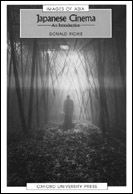 For those interested in a full view of Japanese cinema, the books of Donald Richie cannot be bettered. No one is a greater authority on the evolution of Japanese cinema than Richie. He's lived through half of it. Already a movie buff when he first touched on Japanese shores in 1947 at the tender age of 23 as part of the US Occupation forces, he wrote pioneering studies on Ozu and Kurosawa in the 50s, rubbed shoulders with the leading lights of the New Wave movement in the 60s and even directed 39 films of his own, from 8mm experimental shorts to a 1975 documentary on Kurosawa.
That said, his Japanese Cinema: An Introduction, published in 1990 by Oxford University Press is not really worth going out of your way to get hold of. There's nothing wrong with the content, but at only 88 pages it is ludicrously overpriced. Still, as an overview it is pretty informative as it charts the early days from the arrival of the first imported films in 1897 to Japan's own ambitious first steps in the medium, all the way up until more recent works such as Mitsuo Yanagimachi's Fire Festival in the 80s. However, Richie's dominant focus on the early years, with little space devoted to post-60s developments won't appeal to everyone, mainly because it's so hard to see many of the films under discussion. Including a glossary, bibliography and a nice selection of stills (some in colour), this small hardback certainly has its uses, but there's better value material available from the same author.
Availability
Japanese Cinema - An Introduction

Oxford University Press
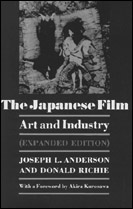 Infinitely more worthy of recommendation for example, at over five times longer for about the same price is what is generally considered the definitive text on Japanese cinema, The Japanese Film: Art and Industry, co-written with Joseph L. Anderson. First published in 1959, the book was re-issued in 1982 in an expanded edition to take in the subsequent 20 years. Again, the focus is more on the early developments, covering much the same ground as Richie's Introduction but in considerably more detail as it covers the industry's historic origins and the birth of the major companies, Nikkatsu, Shochiku, Daiei, and Toho, the work of early pioneers such as Daisuke Ito (with films such as the superbly titled Man-Slashing, Horse-Piercing Sword in 1930) and Teinosuke Kinugasa (the Eisenstein-influenced expressionism of A Page of Madness in 1928), and how the lie of the land was influenced by the likes of Ozu, Kinoshita and Kurosawa.
This historic perspective is what elevates the book above all the others on review here. Subjects such as early developments in Japanese silent film may not sound particularly inspiring, but there's some revelatory material here, especially on the role of the benshi, the narrators of early silent films whose running voice-over commentary was considered an integral part of the cinema experience and whose status in the early days outstripped that of the actual actors appearing in the films. With their existence threatened by the coming of talkies, the powerful influence of these major players as they unionised and went on strike to protect their interests hindered the coming of the sound era by several years (the first successful talkie being Heinosuke Gosho's The Neighbour's Wife and Mine in 1931, though this new type of film didn't really get underway properly until several years later).
There are plenty of other fascinating insights too, including how wartime propaganda films were nurtured under the Office of Public Information, whose monopoly of raw film stock as a "war material" meant that the studios were forced to make the type of films the State demanded; the birth of the documentary by way of the wartime newsreel; Japan's influence on cinema in its occupied territories such as Manchuria, Burma and Taiwan; the subsequent blacklisting of a number of prominent industry figures accused of war crimes; the censorship of film scripts by the Occupying forces, and the sensation of Japan's first onscreen kiss in Yasushi Yasaki's Twenty-Year-Old Youth in 1946 (all kisses had previously been cut from imported foreign films).
Anderson and Richie's book is an invaluable resource, covering far more ground than any of the other books reviewed here and a whole host seminal works that have either been forgotten or lost all the way up to the New Wave and beyond. However, for a book that claims to cover the main significant developments of the industry, some readers might question the absence of the likes of Seijun Suzuki, Kinji Fukasaku and Nikkatsu's Roman Porno films from these pages, as well as Godzilla's relegation to a mere passing mention. Perhaps such omissions are best explained away in terms of when the book was originally written rather than any inherent snobbery on the behalf of the authors.
Availability
The Japanese Film - Art and Industry

Oxford University Press